


By Patrick Hughes, NEMA SVP of Strategy, Technical, and Industry Affairs
Twenty-five years after September 11, 2001, we remember those who lost their lives in New York City, at the Pentagon, and in Pennsylvania. We honor the courage of first responders and recognize the lasting impact on survivors and families. Their loss remains part of our national identity. For those working to protect the traveling public, remembrance also carries a responsibility: to sustain the vigilance and cooperation that aviation security demands.
Congress created the Transportation Security Administration (TSA) through the Aviation and Transportation Security Act, signed into law on Nov. 19, 2001. Today, TSA screens an average of 2.5 million of passengers each day at 440 airports across the country. Supporting that mission requires trained people and technology that can work together as threats and screening methods evolve.
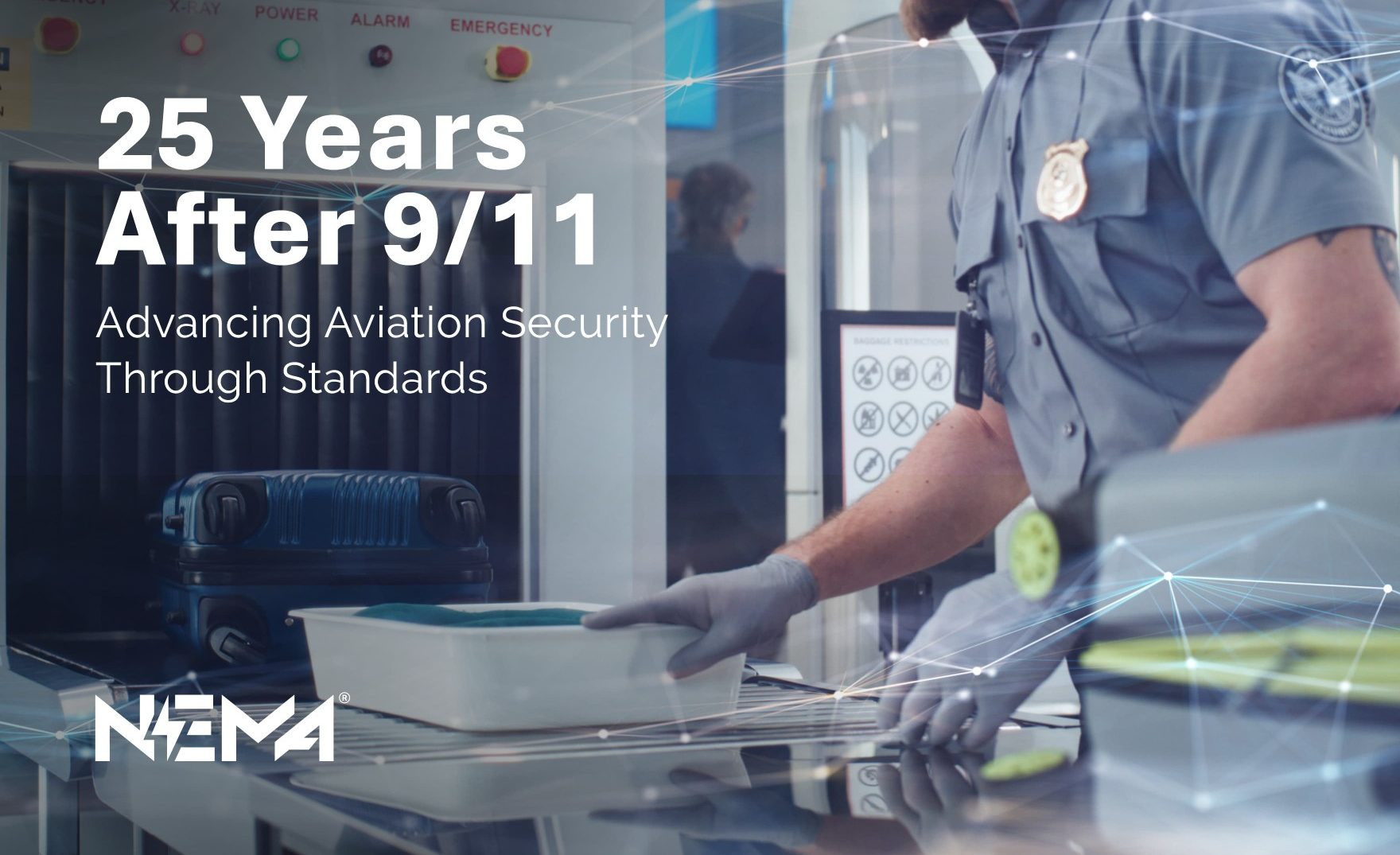
Consider a bag passing through an airport scanner. The machine produces an image that software then analyzes for potential threats. When equipment and software come from different manufacturers, they need a reliable way to exchange and interpret that information seamlessly and securely. That ability is called “interoperability.”
To help meet that need, the National Electrical Manufacturers Association (NEMA) worked with TSA, Battelle, equipment manufacturers, and technical experts to develop the Digital Imaging and Communications in Security standard, known as DICOS, in 2010. It gives screening technologies a common language for exchanging images and related information. When you and your bags pass through security, DICOS helps the equipment and TSA staff identify potentially dangerous items at an enhanced level of speed and accuracy.
DICOS—now in its fifth edition—covers information from X-ray and computed tomography (CT) equipment, personnel-screening systems, and trace-detection devices. Common formats help connect these technologies with the software used to review their output. They also make it easier to integrate updated software and new threat-detection tools.
This matters when screening technology improves. A new analytical tool needs to work with the images a scanner produces. Establishing shared rules for that exchange can reduce the need for custom connections and make improvements easier to incorporate. In fact, TSA identifies DICOS as one of the foundational standards supporting its Open Architecture initiative, which aims to make security hardware and software more interoperable and easier to improve. TSA continues supporting DICOS development through NEMA, helping the standard evolve alongside screening needs.
No standard can eliminate every security threat. But common standards help the people responsible for aviation security connect systems and adapt as technology and threats change. DICOS illustrates the practical cooperation among government, manufacturers, and technical experts that this work requires.
On this anniversary, we remember the lives taken and the families forever changed. The work of keeping aviation safe can never erase that loss, but it is one way we honor those we lost: by refusing to become complacent, by continuing to innovate, and by doing everything we can—day after day—to help ensure that millions of people can leave home, board a plane, and return safely to the people waiting for them.